Cat Toy Rotation System: How to Keep Indoor Cats Interested Without Buying More
Somewhere in your house there is a basket of cat toys. Your cat walked past it this morning without a second glance. That is not because the toys are bad. It is because they have become furniture. Cats are wired to notice what is new and to chase what moves unpredictably, and a toy that has sat in the same spot for three weeks reads as part of the carpet. Rotation solves that without a trip to the pet shop: it is less about owning more toys and more about controlling how much novelty your cat sees at once.
Why the Same Toys Stop Working
Cats habituate quickly. Once a mouse on a string has been pounced on forty times and always behaves the same way, the payoff drops and your cat stops caring. Leaving everything out at once makes this worse, because the whole collection blurs into background noise.
The fix is counterintuitive: fewer toys visible, more variety over time. Keep three or four items on the floor or in a shallow tray, pack the rest away where your cat cannot see or smell them, and bring out a different set every few days. A felt mouse that reappears on Thursday is genuinely more interesting than the same mouse that never left.
Build a Rotation Set in One Afternoon
Gather every toy in the house, including the ones wedged under the sofa. Sort them into rough categories, then split the pile into three or four groups with a mix of types in each group.
- Sort by category. Wand toys, kickers, balls, crinkle and rustle toys, food puzzles, and small prey-sized items such as mice or springs.
- Make three or four balanced groups. Each group should have one wand, one kicker or bigger toy, and two or three small ones.
- Store the out-of-play groups in a lidded box. Somewhere your cat does not patrol, like a closet shelf or a high cupboard.
- Put one group out and leave it for three or four days. Long enough to be used properly, short enough that it still feels fresh.
- Wipe, check and swap. Before a group goes back into storage, look for loose bells, split seams or frayed elastic, and wash anything fabric that has been drooled on.
Twice a week is plenty. If your cat is young or particularly active, swap every two days; for an older cat who sleeps most of the afternoon, once a week may be enough.
A Simple Weekly Schedule
Pick two fixed swap days so you do not have to remember anything, and pair each swap with a play session so the novelty lands at the right moment.
- Sunday evening: wash the outgoing set, put out a fresh group, then a ten-minute wand session.
- Wednesday morning: swap groups again before you leave for the day, so there is something new to find while you are out.
- Any evening: one short session with the wand already out, changing the lure rather than the wand.
Play Sessions Matter More Than the Toys
A rotating pile of toys will not do much on its own. Cats need a hunting partner, and that is your job. Two sessions a day, roughly ten to fifteen minutes each, will do more for an indoor cat than any shopping spree.
Move the wand like prey, not like a toy on a pendulum. Let it dart, stop, hide behind a chair leg, creep along the baseboard, then sprint. Pause often. When your cat stalks and freezes, slow everything down and let the tension build.
Most importantly, let them win. End the session by letting your cat catch the lure, then follow it with a small treat or their next meal. The sequence of stalk, chase, catch and eat is what makes the game satisfying, and a cat who never catches anything loses interest fast. If you can, feed right after playing rather than leaving food down all day.
Refresh Your Wand Toy Without Buying a New One
The wand handle and string rarely need replacing. What wears out is the lure, and that is the part your cat actually cares about. Tie lures on with a small swivel snap clip, the kind sold for fishing, so you can change them in seconds.
Lure ideas that cost almost nothing:
- A strip of fleece or felt cut into a tail shape
- A crumpled piece of tissue paper or a foil ball threaded on the line
- A few feathers from a craft store, tied in a bundle
- A short length of thick ribbon, knotted at the end
- The plastic cap from a milk jug, or a large bead, for a rattling chase toy
Change the lure every week or two and the wand feels new again. Add a bell for a few days, then remove it, so the sound stays surprising rather than constant.
Safety note: any toy on a string should be put away after play, not left out. String, ribbon and elastic are swallowing hazards if a cat chews through them unsupervised, and swallowed linear material can cause serious internal damage. If you suspect your cat has eaten any, contact your vet promptly.
Stretch the Novelty Further
Toys are only one source of interest. Rotate the setting too, and the same objects keep working:
- Scent. Store a few fabric toys in a sealed bag with a pinch of catnip or silvervine for a week before they go out. Not every cat responds, and the effect fades if it is always available.
- Containers. A toy dropped into a paper bag with the handles cut off, a shallow cardboard box, or a paper grocery sack becomes a puzzle instead of a toy.
- Location. Move the visible toy group to a different room each swap. A hallway or a windowsill can make an old ball interesting again.
- Food puzzles. Rotate these like toys, one or two at a time, so mealtime stays a problem to solve.
If your cat seems restless, overgrooms, gains weight, or starts yowling at night, boredom may be part of it, but sudden behaviour changes can also point to a health problem. Have a vet take a look rather than assuming it is only a play issue.
The Five-Minute Weekly Reset
Pick one evening a week and run the whole system in five minutes. Empty the visible toys into the storage box, check the seams and strings, wipe down anything plastic, and put out a different group. Then play for ten minutes with a freshly tied lure and end with a catch and a snack.
That is the entire method. Store more than you show, swap on a schedule you will actually keep, and spend your energy on the play session rather than on the next purchase. Your cat gets a house that keeps changing. You get a cupboard that finally has a purpose.
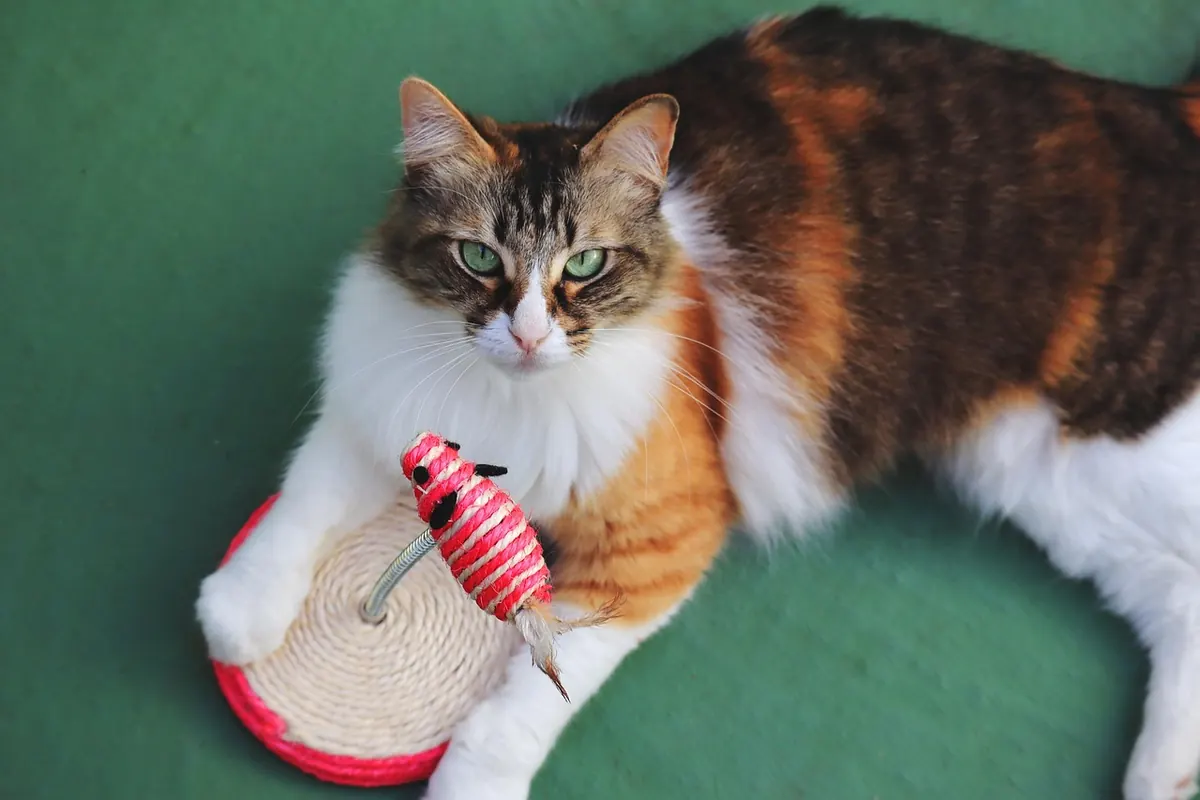
Photo: ChristianBodhi / Pixabay